From Queensland to Singapore: Good practice in supporting language development at university

What does good practice mean when you work in a language unit at a tertiary institution? You are tasked to make language development possible so that students can meet the challenges presented to them. Specifically, the language demands placed on them at this level. So how do you approach it?

Continue reading

Putting the seal on it: Applied linguistics is a discipline of design

I was heartened by a comment of one of the anonymous reviewers of the manuscript of my new book, A Theory of Applied Linguistics: Imagining and Disclosing the Meaning of Design (2024; Springer). It reads:

The strength of this work lies in its … rich and perceptive exemplifications and references spanning over fifty years.

So, we have examples to illustrate the point, and experience that acknowledges history.

Continue reading

Radio podcast: University preparedness in the spotlight again

How prepared are new students for the language demands of higher education? This was again scrutinized in an interview today that Ina Strydom conducted with Tobie van Dyk and me. The topic: academic literacy. Ina Strydom presents the very popular radio programme ‘Taaldinge’ on RSG (Radio Sonder Grense) every Sunday morning, and we were astonished at the amount of positive feedback we received from both those who knew us and from complete strangers.

So: here is the link to the podcast: https://omny.fm/shows/taaldinge/taaldinge-23-april-2023.

The interview is in Afrikaans, but I’d be willing to discuss what was said with anyone who is interested, and who may not be fluent in this. Just let me know.

And yes! Tobie and I would very much like to have your feedback too!

RSG potgooi: Voorbereiding vir universiteit

Is nuwe aankomelinge taalgereed vir universiteit? Dit was vandag weer in die kollig in ’n onderhoud wat Ina Strydom met my en Tobie van Dyk gevoer het oor “Akademiese geletterdheid”. Ina Strydom bied die populêre radioprogram ‘Taaldinge’ elke Sondagoggend aan op RSG (Radio Sonder Grense). Ons was verstom oor die baie positiewe terugvoer wat ons van bekendes en vreemdelinge ontvang het.

So: as jy nie daarna geluister het nie, hier is ’n skakel na die potgooi.: https://omny.fm/shows/taaldinge/taaldinge-23-april-2023. Die onderhoud is in Afrikaans, maar ons kan ook in Engels daaroor gesels. Skakel gerus.

En ja! Tobie en ek sal graag ook jou terugvoer wil hê!

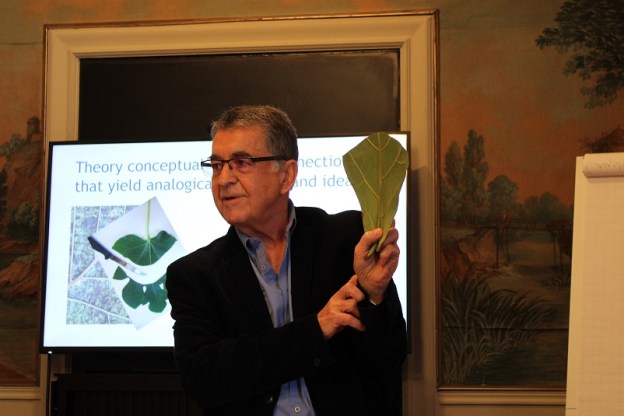
Albert Weideman presenting at Ghent University

How hot is ‘hot’? How practical can theory be?

When Kees de Bot asked a few hundred applied linguists in 2015 whether they needed to have a theory of the field, he found that they thought they did not (De Bot, K. 2015. A history of applied linguistics: From 1980 to the present. London: Routledge). Are they missing something?

Continue reading

Another angle: Examining applied linguistics philosophically

Language assessment is a subfield of applied linguistics. That sounds like a reasonably incontestable statement. But can we simply assume that language assessment is a subfield of applied linguistics? In examining what has been written about that, we find that the claim is widespread — in fact since the earliest times, when applied linguistics was being established by the likes of Pit Corder and Alan Davies more than 50 years ago. Even to this day, language assessment scholars like McNamara make the claim quite confidently.

Continue reading

Review of “Assessing Academic Literacy in a Multilingual Society”: “… an excellent collection of contemporary research”

We are very pleased with the review that Alan Urmston recently wrote in the Journal of English for Academic Purposes. You can read it here: Book review: Assessing Academic Literacy in a Multilingual Society: Transition and Transformation.

South African language assessment on the map

Assessing academic literacy in a multilingual society: Transition and transformation has just appeared in print from Multilingual Matters. I was privileged to co-edit this with the highly experienced John Read of the University of Auckland and my former head of department, Theo du Plessis.

As further contributors there were Tobie van Dyk (NWU), Alan Cliff (UCT), Colleen du Plessis (UFS), Avasha Rambiritch (UP), Kabelo Sebolai (SU), Laura Drennan (UFS), Jo-Mari Myburgh-Smit (UFS), Sanet Steyn (UCT), and a number of co-contributors to some chapters, including Linda Alston, Marien Graham (both UP), Piet Murre (Driestar Hogeschool) and Herculene Kotze (NWU). Most of them are steeped professionally in designing academic literacy interventions and assessments.

Continue reading