A tribute to Christo van Rensburg

Christo van Rensburg, who died last week, was not only one of South Africa’s leading linguists, but also a considerable influence on my own work. It was particularly his voluminous report on Griqua Afrikaans that first brought him fame. My own debt to him is manifold: not only was he the supervisor of my doctoral thesis, but after he had set up and directed what eventually became known as the Unit for Academic Literacy at the University of Pretoria, he was instrumental in having me appointed as his successor. Continue reading
 Responsible design of language plans, courses or tests starts with the employment of one’s technical imagination, while allowing the design to be guided by the following principles:
  The evaluation of language programme and instruction quality is highly relevant, everywhere. To test the effectiveness of a language intervention programme, one needs to take a holistic approach. For a language intervention to be effective, the designer has to bring into harmony five components: policy prescription, curriculum, instruction, learning and assessment When these are aligned, we have the golden pentagon of language intervention design. Where to begin?
  The Code of Ethics of the International Language Testing Association (ILTA) is a guide to language testers of how they should conduct their business in ways that are caring and compassionate, and at the same time deliberate and professional. It is complemented by locally formulated Codes of Practice. The Code of Ethics is already available in eleven languages.
 Returning to the still unresolved issue of how best to conceptualize test validation and validity, I attempt to answer this question in a special issue of Language & Communication that commemorates the work of the late Alan Davies. In particular, I argue that responsible test design encompasses ethicality and accountability and is a conceptually clearer way of thinking about the quality of a language test.
 If you were a scientist working in the 1950’s, you would claim that your work, the theory that you subscribed to, and the results of your academic endeavours were all neutral and objective. In the heydays of modernism, the mere suggestion that there were any external, non-scientific influences on your work would have implied a threat to the integrity of that work.
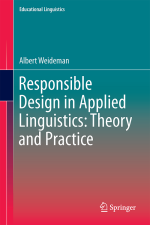 Is a theory of applied linguistics desirable? And if so, is it possible? My new book, Responsible design in applied linguistics: theory and practice (2017; Springer) proceeds from the thesis that applied linguistics needs a theoretical foundation. It is indeed possible to delineate its work (and specifically distinguish it from linguistics). Providing it with a theoretical foundation might additionally yield new insight into the principles that underlie applied linguistic designs. Those designs we encounter as the interventions that we call language courses, language tests and language policies.
  Avasha Rambiritch of the University of Pretoria and I have just written a chapter for a book edited by John Read (Post-admission Language Assessment of University Students, Springer, 2016) that shows how making sufficient information available about the conception, design, development, refinement and eventual administration of a test of language ability — in other words “telling the story of a test” — is the first step towards ensuring accountability for such tests. The test in question, the Test of Academic Literacy for Postgraduate Students (TALPS), is used to determine the academic literacy of prospective postgraduate students. For the full reference, see the
  Albert Weideman