What does good practice mean when you work in a language unit at a tertiary institution? You are tasked to make language development possible so that students can meet the challenges presented to them. Specifically, the language demands placed on them at this level. So how do you approach it?
Language assessment is a subfield of applied linguistics. That sounds like a reasonably incontestable statement. But can we simply assume that language assessment is a subfield of applied linguistics? In examining what has been written about that, we find that the claim is widespread — in fact since the earliest times, when applied linguistics was being established by the likes of Pit Corder and Alan Davies more than 50 years ago. Even to this day, language assessment scholars like McNamara make the claim quite confidently.
The journalist and scholar H.L. Mencken (1880-1956) once observed that “For every complex problem there is an answer that is clear, simple, and wrong.” One would think that academic literacy, the ability to use academic language competently, would be the first and only language concern of the academic communities that make up the university. Such is the complexity of language problems, however, that not all solutions for them will have to do with making education and study more effective. Student communities may, for example, make language demands that are primarily politically inspired, and have little bearing on scholarship. When decision-makers yield to the politically expedient solution, that solution may be rationalized in many ways that might have the pretence of having to do with education, but that actually has no theoretical justification. There are at least two recent cases in South Africa where the language policies of universities were changed for reasons other than academic ones, with negative consequences that were foreseen, but ignored. Continue reading →
There is something reassuring for university administrators and decision-makers in using the results of large-scale tests. They seldom worry about their contextual appropriateness, or about their cost, or even enquire about their quality. The large reach of the test in their minds ensures its reputation. As to costs? Well, the argument goes, if students wish to undertake studies at this university, they must be prepared to pay for that privilege. Continue reading →
What influence does the institutional, social or political landscape have on the way in which we test a person’s ability to handle academic language? And how should one go about it? What impact should the tests have on language planning, instruction, and development?
Responsible design of language plans, courses or tests starts with the employment of one’s technical imagination, while allowing the design to be guided by the following principles: Continue reading →
The evaluation of language programme and instruction quality is highly relevant, everywhere. To test the effectiveness of a language intervention programme, one needs to take a holistic approach. For a language intervention to be effective, the designer has to bring into harmony five components: policy prescription, curriculum, instruction, learning and assessment When these are aligned, we have the golden pentagon of language intervention design. Where to begin? Continue reading →
Is a theory of applied linguistics desirable? And if so, is it possible? My new book, Responsible design in applied linguistics: theory and practice (2017; Springer) proceeds from the thesis that applied linguistics needs a theoretical foundation. It is indeed possible to delineate its work (and specifically distinguish it from linguistics). Providing it with a theoretical foundation might additionally yield new insight into the principles that underlie applied linguistic designs. Those designs we encounter as the interventions that we call language courses, language tests and language policies. Continue reading →


 Responsible design of language plans, courses or tests starts with the employment of one’s technical imagination, while allowing the design to be guided by the following principles:
  The evaluation of language programme and instruction quality is highly relevant, everywhere. To test the effectiveness of a language intervention programme, one needs to take a holistic approach. For a language intervention to be effective, the designer has to bring into harmony five components: policy prescription, curriculum, instruction, learning and assessment When these are aligned, we have the golden pentagon of language intervention design. Where to begin?
 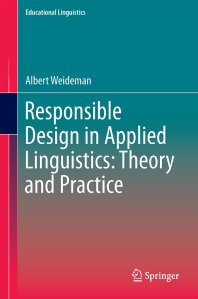 Is a theory of applied linguistics desirable? And if so, is it possible? My new book, Responsible design in applied linguistics: theory and practice (2017; Springer) proceeds from the thesis that applied linguistics needs a theoretical foundation. It is indeed possible to delineate its work (and specifically distinguish it from linguistics). Providing it with a theoretical foundation might additionally yield new insight into the principles that underlie applied linguistic designs. Those designs we encounter as the interventions that we call language courses, language tests and language policies.
  Albert Weideman