I spearheaded the development of a range of tests of academic literacy, general language proficiency, and workplace communication.
Testing academic literacy

These tests all measure a construct that relies on a definition of academic literacy that is widely accepted and has been thoroughly researched, reconsidered and used in academic literacy designs.
- ALLTEST – Academic Literacy Levels Test
- ALTSIT – Academic Literacy Test of the Singapore Institute of Technology
- TALL – Test of Academic Literacy Levels
- TAG – Toets van Akademiese Geletterdheidsvlakke
- TAGNaS – Toets van Akademiese Geletterdheid vir Nagraadse Studente
- TAL – Test of Academic Literacy for Prospective Students of Nursing
- TALPS – Test of Academic Literacy for Postgraduate Students
- TEL – Test of Emergent Literacy for 5–6-year-olds
- TEAL – Test of Early Academic Literacy
- TALA – Test of Advanced Language Ability
- Test of academic literacy for disaster management at postgraduate level
More information on these tests on the ICELDA website … or contact me directly on albert@lcat.design
Testing general language proficiency

On behalf of ICELDA I have developed a test of general language proficiency for a South African university of technology. They plan to use this to gauge the language readiness of first year students.
The ERL is a test developed for a private education provider in Singapore by Language Courses and Tests (LCaT).
- ERL – Estimate of Reading Level
- ProficiT – Proficiency test – English
Testing workplace communication

With Language Courses and Tests (LCaT), I have designed, developed and implemented two tests, in English and Afrikaans, of professional communication for call centre employees, called APLAC.
ALEF is used to test the language ability of prospective employees in the financial sector.
- APLAC – Assessment of Professional Language Capacity
- ALEF – Assessment of Language for Economics and Finance
PUBLICATIONS
 Items marked with the Adobe icon are either ‘open access’ or accepted manuscripts prior to publication and can be downloaded freely.
BOOKS AND BOOK CHAPTERS
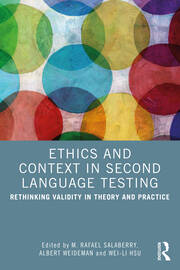
Ethics and Context in Second Language Testing: Rethinking Validity in Theory and Practice
Edited by M. Rafael Salaberry, Albert Weideman & Wei-Li Hsu (2024). Routledge.
CHAPTER 1: Context, construct, and ethics
By M. Rafael Salaberry, & Albert Weideman
Free preview >
CHAPTER 2: Validity and validation: An alternative perspective
By Albert Weideman & Bart Deygers
CHAPTER 9: Yardsticks for the future of language assessment: Disclosing the meaning of measurement
By Albert Weideman
| CITATION |
|---|
| Salaberry, M. Raphael & Weideman, Albert & Wei-Li Hsu. (Eds.). 2024. Ethics and Context in Second Language Testing: Rethinking Validity in Theory and Practice. Routledge. https://doi.org/10.4324/9781003384922 |

Advancing professionalisation: The achievement of language assessment literacy [Book chapter].
(2024) Cambridge University Press.
- Traces the growth of interest in language assessment literacy (LAL)
- Draws upon a set of systematic criteria to analyse these chronological developments
- Suggests that LAL has brought about several advances in the professional understanding of language testing
| CITATION |
|---|
| Weideman, A. 2024. Advancing professionalisation: The achievement of language assessment literacy. In B. Baker & L. Taylor (Eds.) Language Assessment Literacy and Competence Volume 1: Research and Reflections from the Field (pp. 239-249). Cambridge University Press. |

Assessing Academic Literacy in a Multilingual Society: Transition and Transformation
Edited by Albert Weideman, John Read, Theo du Plessis (2021) Multilingual Matters.
The book focuses on assessing the academic language and literacy levels of South African students to identify those who need further development to succeed in higher education.
CHAPTER 2: A skills-neutral approach to academic literacy assessment
By Albert Weideman
CHAPTER 6: How early should we measure academic literacy?
By Jo-Mari Myburgh-Smit & Albert Weideman
| CITATION |
|---|
| Weideman, A., Read, J., & Du Plessis, L.T. (Eds.) 2021. Assessing Academic Literacy in a Multilingual Society: Transition and Transformation. (New Perspectives on Language and Education; no. 84.) Bristol: Multilingual Matters. |

The refinement of the idea of consequential validity within an alternative framework for responsible test design [Book chapter]
Albert Weideman (2017) Routledge.
The problematic secondary school exit-level examinations for home languages in South Africa illustrate a dilemma with high-stakes assessments. In order to resolve it, the refinement of the idea of consequential validity (Messick) is considered. An alternative conceptualisation of the principles that inform the design of language tests may mitigate the potentially negative social and economic impact of high-stakes language tests.
| CITATION |
|---|
| Weideman, A. 2016.The refinement of the idea of consequential validity within an alternative framework for responsible test design. In: Allan, Julie and Artiles, Alfredo J. (Eds.) World Yearbook of Education 2017: Assessment Inequalities. London: Routledge, Taylor and Francis Group. |
Construct refinement in tests of academic literacy [Book chapter]
Albert Weideman, Rebecca Patterson, Anna Pot (2016)
Using the characteristic feature of academic discourse as a criterion can help refine the current test construct of academic literacy tests that are widely used in South Africa, such as TALL, TAG (the Afrikaans counterpart of TALL), and TALPS, as well as a new test of academic literacy for Sesotho. Post-entry tests of language ability (PELAs) can also be utilised more efficiently, as a recent analysis of diagnostic information from TALPS has shown.
| CITATION |
|---|
| Weideman, A., Patterson, R. & Pot, A. 2016. Construct refinement in tests of academic literacy. In: Read, J. (Editor). Post-admission Language Assessment of University Students. Cham: Springer, Chapter 9, pp. 179-196. DOI: 10.1007/978-3-319-39192-2_9. |
Telling the story of a test: the Test of Academic Literacy for Postgraduate Students (TALPS) [Book chapter]
Avasha Rambiritch, Albert Weideman (2016)
In telling the story of TALPS, and in highlighting how issues of fairness have been considered seriously in its design and use, we hope to answer a key question that all test designers need to ask: Have we, as test designers, succeeded in designing a socially acceptable, fair and responsible test?
| CITATION |
|---|
| Rambiritch A. & Weideman, A. 2016. Telling the story of a test: the Test of Academic Literacy for Postgraduate Students (TALPS). In: Read, J. (Ed.) Post-admission Language Assessment of University Students. Cham: Springer, Chapter 10, pp. 197-216. DOI: 10.1007/978-3-319-39192-2_10. |

Academic literacy: Five new tests
Albert Weideman (2018)
A workbook of practice tests and answers for prospective university students to prepare them for any test of academic and quantitative literacy (AQL) required by a university.
INTRODUCTION: Academic literacy: Why is it important?
| CITATION |
|---|
| Weideman, A. 2018. Academic literacy: Why is it important? [Introduction]. In: Academic literacy: Five new tests. Bloemfontein: Geronimo, p. ii-x. |
ARTICLES
My top 5 articles on language test design
 Weideman Albert & Van Dyk, Tobie. 2023. Achieving technical economy: A modification of cloze procedure. Language Teaching Research Quarterly 37 (Special issue in honour of James Dean Brown’s five-decade contribution to language testing and assessment). https://doi.org/10.32038/ltrq.2023.3X.0x
Weideman, Albert. 2022. Context, construct, and validation: A perspective from South Africa. Language Assessment Quarterly 19(2): 124-141. https://doi.org/10.1080/15434303.2020.1860991
Weideman, Albert. 2020. Complementary evidence in the early-stage validation of language tests: Classical Test Theory and Rasch analyses. Per Linguam 36(2): 57-75. https://doi.org/10.5785/36-2-970.
Weideman, Albert. 2019. Degrees of adequacy: the disclosure of levels of validity in language assessment. Koers: Bulletin for Christian Scholarship 84(1): 1-15. DOI: 10.19108/KOERS.84.1.2451.
Weideman, Albert. 2019. Validation and the further disclosures of language test design. Koers: Bulletin for Christian Scholarship 84(1): 1-10. DOI: 10.19108/KOERS.84.1.2452.
More perspectives on language test design
Green, Jonathan, Weideman, Albert, Davis, Charmaine, Judith, Kate & Harmes, Marcus. 2024. Using a five-phase applied linguistics design to develop a contextualized academic literacy placement test for pre-university pathway students. Literacy Research and Instruction, 1-27. https://doi.org/10.1080/19388071.2024.2340031
Schildt, Laura, Deygers, Bart & Weideman, Albert. 2023. Language testers and their place in the policy web. Language Testing (Online first: article first published online on 17 August). https://doi.org/10.1177/02655322231191133
Drennan, Laura, Joubert, Michelle, Weideman, Albert & Posthumus, Rohan. 2021. Combined measures of identifying language risk for first-year students. Journal for Language Teaching 55(2): 93-116. https://doi.org/10.4314/jlt.v55i2.4
Weideman, Albert. 2019d. Assessment literacy and the good language teacher: Four principles and their applications. Journal for Language Teaching 53(1): 103-121. https://doi.org/10.4314/jlt.v53i1.5
Weideman, Albert. 2017. Does responsibility encompass ethicality and accountability in language assessment? Language & Communication, 9p. https://doi.org/10.1016/j.langcom.2016.12.004
Weideman, A. & Pot, A. 2015. Diagnosing academic language ability: An analysis of the Test of Academic Literacy for Postgraduate Students. Language Matters 46(1): 22-43. https://doi.org/10.1080/10228195.2014.986665.
Weideman, A. & Patterson, R. 2013. The typicality of academic discourse and its relevance for constructs of academic literacy. Journal for Language Teaching 47(1): 107-123. DOI: 10.4314/jlt.v47i1.5
Weideman, A. & Patterson, R. 2013. The refinement of a construct for tests of academic literacy. Journal for Language Teaching 47(1): 125-151. DOI: 10.4314/jlt.v47i1.6
Weideman, A. 2012. Validation and validity beyond Messick. Per Linguam 28(2): 1-14. DOI: 10.5785/28-2-526
Weideman, A. 2011. Academic literacy tests: design, development, piloting and refinement. Journal for Language Teaching 45(2): 100-113.
Weideman, A. & Le, P.L. & Du Plessis, C.L. 2011. Test and context: The use of the Test of Academic Literacy Levels (TALL) at a tertiary institution in Vietnam. Journal for Language Teaching 45(2): 115-131.
Weideman, A. 2009. Constitutive and regulative conditions for the assessment of academic literacy. Southern African Linguistics and Applied Language Studies (Special issue: Assessing and developing academic literacy) 27(3): 235-251. DOI: 10.2989/SALALS.2009.27.3.3.937. See Alan Davies’s commentary on this article.
Weideman, A. & Van der Slik, F. 2009. Examining bias in a test of academic literacy: does the Test of Academic Literacy Levels (TALL) treat students from English and African language backgrounds differently? Journal for Language Teaching 44(2): 106-118. DOI: 10.4314/jlt.v44i2.71793.
Weideman, A. 2006. Assessing academic literacy: A task-based approach. Language Matters 37(1): 81-101. DOI: 10.1080/10228190608566253

Various aspects of language tests developed in South Africa have been scrutinized by scholars in books, theses and accredited journals, not only in South Africa, but elsewhere as well.
For a list of articles, papers and theses, please visit the NExLA Bibliography. NExLA (Network of Expertise in Language Assessment) was established in June 2017.
 Albert Weideman