
What does good practice mean when you work in a language unit at a tertiary institution? You are tasked to make language development possible so that students can meet the challenges presented to them. Specifically, the language demands placed on them at this level. So how do you approach it?
Centre for Professional Communication, SIT
Recently I had the opportunity to return to the Singapore Institute of Technology (SIT) as a visiting professor. My connection with SIT goes back to the previous decade, when I collaborated with the then Centre for Communication Skills – now the Centre for Professional Communication – on designing an entry-level test. This time, my focus has been on reviewing the curriculum for their Critical Thinking and Communication Skills course, as well as engaging with CPC staff and students.

A third opportunity this time was to speak to all SIT staff. What does one say to those colleagues at the receiving end of the language interventions designed for their students by the language support unit, the CPC? My past and present acquaintance with their staff, along with their well-designed course presented organisation-wide to all students, made me consider reminding colleagues – whose students are served by the CPC – of its alignment with good practice elsewhere.
Having been the director of a growing unit for academic literacy at one university, and knowing the inner workings of another at a subsequent tertiary place of work, gave an initial basis for my reflections. But I have also observed, and sometimes worked with, units or organisational interventions as far afield as Queensland, Windhoek, Groningen and Potchefstroom. What does good practice involve in all of these places?
The common strand is …
The common strand for me is: a changed perspective on language – that it is used to do tasks. This has enabled those whose role is the fostering of language development to design language instruction with more care and deliberation than before. Specifically, current language teaching is not only theoretically defensible but is designed to make language learning possible.
Such designs normally have five phases, which I briefly illustrated in my presentation in Singapore.
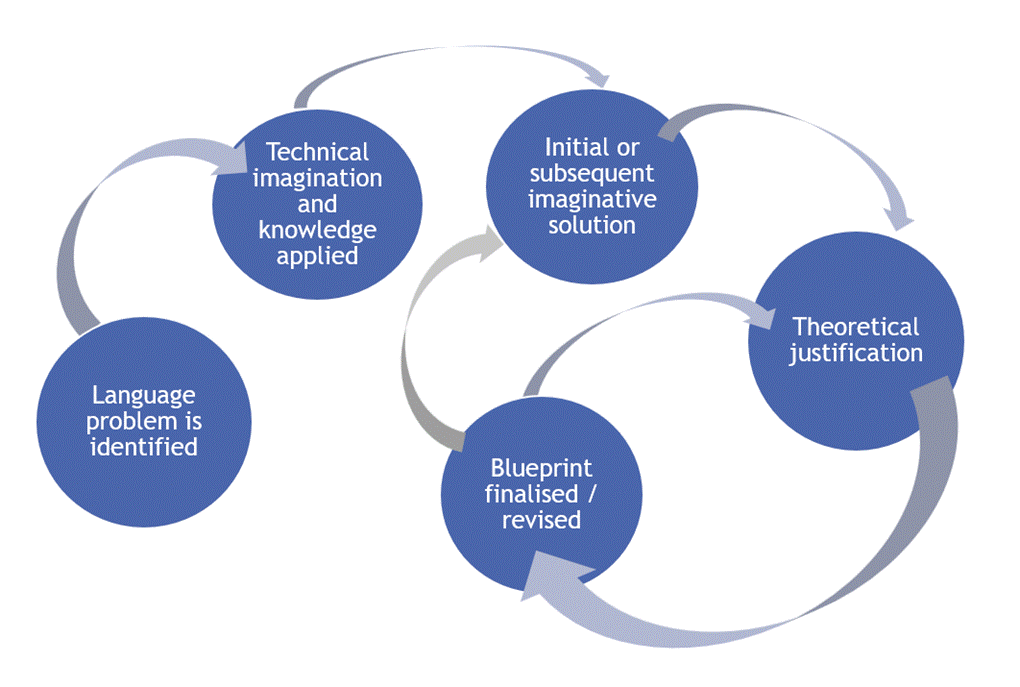
The kind of teaching the CPC at SIT and similar sub-institutional units globally are undertaking do justice to two things. First, it meets the challenge of developing language for higher and continuing education, and second, it faces the complexity of preparing students for the language demands of real-life tasks. Using language to seek new information, to process that information, and to then produce genuinely new information (as opposed to what AI tools generate) is part of the future skills that engineers (or engineers in training, as at SIT), in their own words, will need:
Today’s engineer must be able to communicate with clients, communities and colleagues from other disciplines, in order to understand and interpret their inputs … Without people buying in to your solution, it may never be executed. Technical excellence without communication skills is relatively useless. (Gustav Rohde Former CEO, Aurecon; personal communication, 14 October 2003).
A functional approach
Good practice can be summarized in one phrase: a functional approach. From Potchefstroom to Singapore, that is what is common.
Feel free to request my PowerPoint. Contact me at albert.weideman at ufs.ac.za.
 Albert Weideman
Dear Albert,
I’d love to see your slides. I so agree with you that our focus at adult and university needs to been on teaching language TO DO THINGS!
For younger learners, that may also be a part, but I also believe that it needs to open their eyes and minds to all that they can accomplish (using English or another language). I now say that all the materials I have helped develop for National Geographic Learning are not only content-based, but focused on global communities, issues, possibilities, etc.
If you haven’t seen any of them, take a look at OUR WORLD (for primary grades) IMPACT (for teens)
There are 2 others as well: Welcome to Our World (for pre-primary) Explore Our World (similar to Our World, but for programs which only teach English for a short time each week)
I still hope that someday we can re-connect in person. Do you go to IATEFL? I don’t, but have considered doing so. I did go in the past. I still go to TESOL, but most of my time now is focused on various boards that I serve on and reviewing proposals, etc.
Great to hear from you.
Jodi
JoAnn (Jodi) Crandall Professor Emerita of Education Former Co-Director, MA TESOL Program Former Director, PhD Program in Language, Literacy and Culture University of Maryland Baltimore County (UMBC) Baltimore, MD 21250 crandall@umbc.edu c: +1 (202) 494-5909
>
LikeLike
Many thanks, Jodi! I’ll take a look. And yes, we should really make a plan!
LikeLike
Dear Albert, I trust this message finds you well. I am nursing a cold and the cold mornings and evenings do not help! Thank you very much for the message and distillation. This week, like the previous one, is hectic. I will respond later. With my best wishes, Mbo.
LikeLike
Thanks, Mbongeni! Hope it is soon over!
LikeLike
Dear Albert, Thank you very much.
With my best wishes, Mbo.
LikeLike